

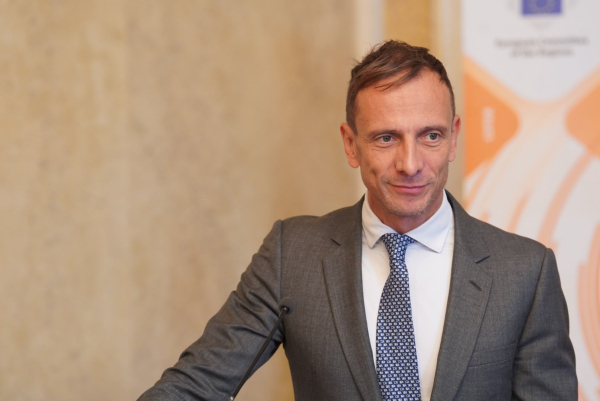
ECR member and President of the Autonomous Region of Friuli Venezia Giulia Massimiliano Fedriga hosted the European Committee of the Regions’ COTER external seminar, bringing regional and local leaders to Trieste to place territories at the centre of Europe’s cohesion, innovation and competitiveness strategies.
Under the title “Regions at the heart of cohesion strategies”, the seminar focused on cohesion policy as a decentralised investment policy and on the added value of multilevel governance. The programme combined debate on industrial transition and innovation with concrete regional projects, territorial strategies and a study visit to the cross-border Piazza Transalpina between Gorizia and Nova Gorica.
“Europe works when policies start from the territories. Shared management, multilevel governance, partnership and a territorial approach are the pillars of cohesion policy. Any form of centralisation, direct or indirect, must be rejected,” said President Fedriga.
ECR members Antonio Aurigemma, Adam Karácsony and Attila Kiss were also present in Trieste, contributing local and regional perspectives to the exchange on the future of cohesion policy and its role in supporting investment, innovation and balanced territorial development.
The first session examined how local action could drive industrial transition and innovation. It featured the work of Select Friuli Venezia Giulia and ERDF-supported projects developing technologies in the health sector and additive manufacturing, followed by reactions from COTER members.
“Regional industrial ecosystems contribute to European competitiveness and sovereignty through knowledge, skills and innovation. Where best practices are shared, those skills are connected, creating capabilities that no territory could build on its own” Mr Fedriga stressed.
The second session turned to territorial strategies supported by cohesion policy. It included Friuli Venezia Giulia’s approach to creating synergies across the territory and the redevelopment of Piazza Transalpina, a tangible example of cross-border cooperation connecting Gorizia and Nova Gorica. The programme concluded with a study visit to the square.
On the future framework, President Fedriga insisted: “When it comes to the discussions on the next MFF, Regions must be able to continue negotiating directly with the Commission and, if they wish, implementing regional programmes, with a guaranteed role at every step of the way. The Cohesion Alliance has summed this up in a phrase that I endorse: no cohesion without representation”.
“Regions are not asking for privileges. They are asking to being able to continue doing what they know how to do: plan, invest and account for results. Not as mere beneficiaries, but as strategic partners of the Union” Fedriga concluded.